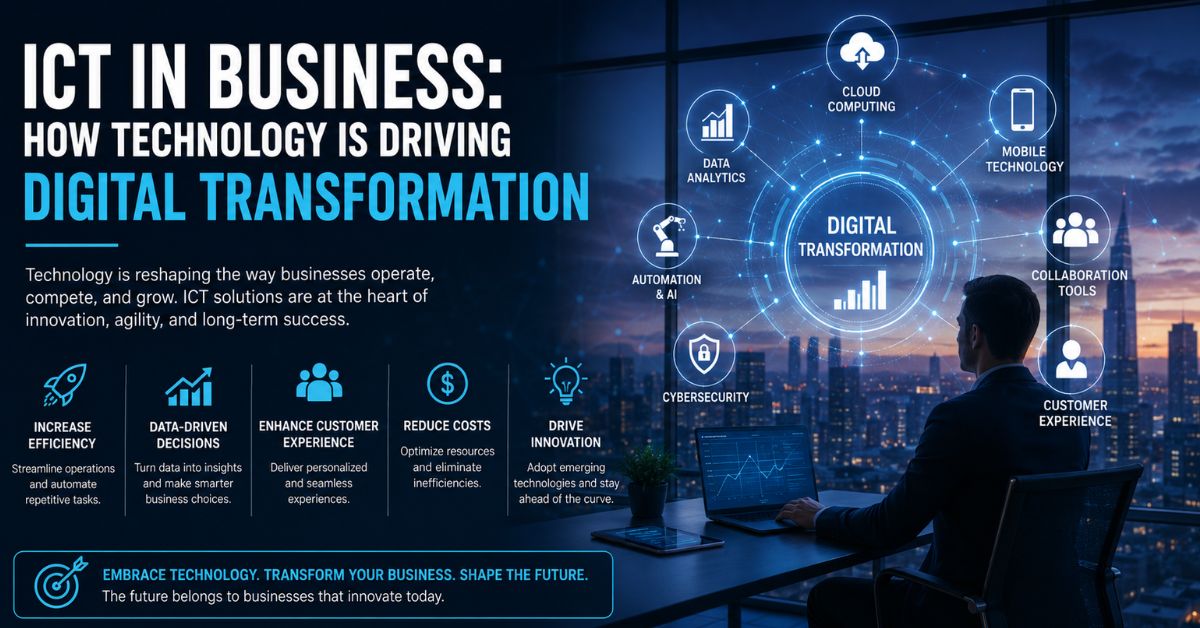
Businesses that fail to embrace technology are falling behind faster than ever.
Digital transformation is no longer a competitive advantage—it is a survival strategy.
The organizations winning today are the ones using ICT to work smarter, serve customers better, and make faster decisions.
Introduction
The business world has undergone a dramatic transformation over the past two decades. Advances in Information and Communication Technology (ICT) have reshaped how companies operate, communicate, compete, and grow. From cloud computing and artificial intelligence to mobile applications and big data analytics, technology has become the driving force behind modern business success.
Organizations of all sizes are investing heavily in digital solutions to improve efficiency, reduce costs, enhance customer experiences, and create new opportunities for innovation. The businesses that embrace digital transformation are becoming more agile, productive, and competitive in an increasingly connected world.
Today, ICT is no longer limited to supporting business operations. It is now at the center of business strategy. Companies use technology to automate processes, analyze customer behavior, optimize supply chains, strengthen cybersecurity, and deliver personalized experiences.
This article explores how ICT is driving digital transformation, the technologies behind this shift, the benefits for businesses, the challenges involved, and what the future holds for organizations navigating the digital age.
What is ICT in Business?
Information and Communication Technology (ICT) refers to the technologies used to create, store, process, transmit, and manage information.
In a business environment, ICT includes:
- Computers and servers
- Internet technologies
- Mobile devices
- Cloud computing
- Software applications
- Communication systems
- Artificial intelligence
- Data analytics platforms
- Cybersecurity solutions
These technologies help organizations improve communication, streamline operations, and support decision-making.
ICT serves as the foundation for digital transformation by enabling businesses to operate more efficiently and respond quickly to changing market demands.
Understanding Digital Transformation
Digital transformation is the process of integrating digital technologies into all areas of a business to improve operations, customer experiences, and overall performance.
It involves more than simply adopting new technologies. It requires organizations to rethink processes, business models, and company culture.
Digital transformation aims to:
- Improve efficiency
- Increase productivity
- Enhance customer satisfaction
- Support innovation
- Reduce operational costs
- Create competitive advantages
Businesses that successfully transform digitally are better positioned to adapt to market changes and customer expectations.
Why ICT is Essential for Digital Transformation
Without ICT, digital transformation would not be possible.
Technology provides the tools and infrastructure organizations need to modernize their operations and create value.
ICT enables businesses to:
- Access real-time information
- Automate repetitive tasks
- Improve collaboration
- Enhance customer engagement
- Make data-driven decisions
- Scale operations efficiently
The growing importance of digital business strategies has made ICT a critical investment for organizations worldwide.
Key ICT Technologies Driving Digital Transformation
Cloud Computing
Cloud computing has become one of the most significant drivers of digital transformation.
Instead of relying on expensive on-site infrastructure, businesses can access computing resources through the internet.
Benefits of cloud computing include:
Scalability
Businesses can increase or decrease resources based on demand.
Cost Savings
Organizations reduce expenses related to hardware, maintenance, and infrastructure.
Remote Access
Employees can access systems and data from anywhere.
Business Continuity
Cloud providers offer backup and disaster recovery solutions.
Cloud technology has enabled organizations to become more flexible and responsive in a rapidly changing environment.
Artificial Intelligence (AI)
Artificial intelligence is transforming how businesses operate and make decisions.
AI technologies can analyze large volumes of data, identify patterns, and automate complex processes.
Common business applications include:
- Customer service chatbots
- Fraud detection
- Sales forecasting
- Predictive analytics
- Personalized marketing
- Inventory management
AI helps organizations improve efficiency while delivering better customer experiences.
Big Data and Analytics
Businesses generate enormous amounts of data every day.
This data comes from:
- Customer interactions
- Sales transactions
- Social media platforms
- Websites
- Mobile applications
- Connected devices
Data analytics tools help organizations turn raw information into valuable insights.
Benefits include:
- Better decision-making
- Improved customer understanding
- Market trend analysis
- Performance optimization
- Risk management
Companies that leverage data effectively often gain a significant competitive advantage.
Internet of Things (IoT)
The Internet of Things refers to networks of connected devices that collect and exchange data.
Examples include:
- Smart sensors
- Connected machinery
- Wearable devices
- Smart logistics systems
Businesses use IoT to:
- Monitor equipment performance
- Improve supply chain visibility
- Reduce downtime
- Enhance operational efficiency
Real-time monitoring allows organizations to make informed decisions quickly.
Mobile Technology
Mobile devices have transformed workplace communication and productivity.
Employees can now:
- Access company systems remotely
- Collaborate in real time
- Manage projects on the go
- Communicate instantly
Mobile technology supports flexible work environments and improves business responsiveness.
Automation and Robotics
Automation allows businesses to reduce manual effort and increase efficiency.
Automated systems can handle:
- Data entry
- Customer inquiries
- Manufacturing processes
- Invoice processing
- Inventory tracking
Automation reduces human error and frees employees to focus on higher-value activities.
Cybersecurity Solutions
As businesses become more digital, cybersecurity has become increasingly important.
Cybersecurity technologies help protect:
- Customer information
- Financial data
- Intellectual property
- Business operations
Strong cybersecurity measures are essential for maintaining trust and preventing costly breaches.
How ICT Improves Business Operations
Streamlining Processes
Many traditional business processes are time-consuming and inefficient.
ICT solutions help automate workflows, reducing delays and improving accuracy.
Examples include:
- Automated payroll systems
- Digital document management
- Online approval workflows
- Customer relationship management systems
Organizations can accomplish more with fewer resources.
Enhancing Communication
Effective communication is critical for business success.
ICT tools such as:
- Video conferencing
- Instant messaging
- Collaboration platforms
- Email systems
enable teams to communicate seamlessly regardless of location.
Improved communication leads to better teamwork and faster decision-making.
Supporting Remote Work
The rise of remote and hybrid work models has highlighted the importance of ICT.
Cloud-based technologies allow employees to:
- Work from anywhere
- Access files securely
- Collaborate efficiently
- Participate in virtual meetings
Businesses can attract talent globally while reducing office-related costs.
Improving Supply Chain Management
Technology helps businesses monitor and manage supply chains more effectively.
ICT enables:
- Real-time inventory tracking
- Demand forecasting
- Supplier collaboration
- Logistics optimization
These capabilities reduce costs and improve operational efficiency.
ICT and Customer Experience Transformation
Personalization
Customers expect personalized experiences.
ICT enables businesses to analyze customer behavior and preferences.
Organizations can deliver:
- Personalized recommendations
- Targeted promotions
- Customized communication
Personalization increases customer satisfaction and loyalty.
Faster Customer Support
Technology has improved customer service significantly.
Businesses use:
- Live chat
- AI chatbots
- Self-service portals
- Customer relationship management software
These tools help organizations respond quickly and efficiently.
Omnichannel Engagement
Customers interact with businesses across multiple channels.
These include:
- Websites
- Social media
- Mobile apps
- Physical stores
ICT enables organizations to provide a consistent experience across all touchpoints.
Related post: Ethical Issues in ICT: Data Privacy, AI Ethics, and Digital Rights
Benefits of ICT-Driven Digital Transformation
Increased Efficiency
Automation reduces repetitive tasks and improves productivity.
Employees can focus on strategic and creative activities.
Better Decision-Making
Access to real-time data helps leaders make informed decisions.
Data-driven organizations often outperform competitors.
Reduced Costs
Digital solutions reduce:
- Administrative expenses
- Infrastructure costs
- Operational inefficiencies
Businesses can allocate resources more effectively.
Improved Agility
Technology enables organizations to adapt quickly to changing conditions.
Agility is critical in competitive markets.
Enhanced Innovation
ICT creates opportunities for:
- New products
- New services
- New business models
Innovation drives growth and long-term success.
Competitive Advantage
Organizations that embrace digital transformation often gain stronger market positions and higher customer loyalty.
Challenges of Digital Transformation
Despite its benefits, digital transformation presents challenges.
Resistance to Change
Employees may resist new technologies or processes.
Successful transformation requires:
- Training
- Communication
- Leadership support
Cybersecurity Risks
Digital systems create potential security vulnerabilities.
Businesses must invest in strong cybersecurity strategies.
High Initial Costs
Technology investments can be expensive.
Organizations must carefully evaluate costs and expected returns.
Skills Gaps
Many businesses struggle to find employees with digital skills.
Continuous learning and workforce development are essential.
Integration Issues
Combining new technologies with legacy systems can be complex and time-consuming.
Careful planning helps minimize disruptions.
Digital Transformation Across Industries
Healthcare
ICT enables:
- Telemedicine
- Electronic health records
- AI-assisted diagnostics
These technologies improve patient care and efficiency.
Retail
Retailers use technology for:
- E-commerce
- Inventory management
- Personalized marketing
Digital solutions enhance customer experiences and increase sales.
Manufacturing
Smart factories use:
- IoT sensors
- Automation
- Robotics
- Predictive maintenance
These innovations improve productivity and reduce downtime.
Finance
Financial institutions leverage:
- Mobile banking
- Artificial intelligence
- Blockchain technology
Digital solutions improve security, convenience, and customer service.
Education
Educational institutions use ICT to deliver:
- Online learning
- Virtual classrooms
- Digital assessments
Technology expands access to education worldwide.
The Future of ICT in Business
Technology continues to evolve rapidly.
Several trends are expected to shape the future of business transformation.
Artificial Intelligence Expansion
AI will become increasingly integrated into daily business operations.
Organizations will use AI to automate decision-making and improve efficiency.
5G Connectivity
Faster networks will support:
- Real-time communication
- Smart devices
- Advanced digital services
Increased Automation
Automation technologies will continue replacing repetitive tasks.
Businesses will focus more on strategic and creative work.
Advanced Cybersecurity
As cyber threats grow, organizations will invest heavily in proactive security measures.
Sustainable Technology
Businesses will adopt environmentally responsible technologies to reduce their carbon footprints.
Best Practices for Successful Digital Transformation
To maximize success, organizations should:
Develop a Clear Strategy
Define goals and align technology investments with business objectives.
Focus on Customer Needs
Technology should improve customer experiences and solve real problems.
Invest in Employee Training
Equip staff with the skills needed to use digital tools effectively.
Prioritize Cybersecurity
Protect systems, data, and customer information.
Embrace Innovation
Encourage experimentation and continuous improvement.
Measure Results
Track performance metrics to evaluate success and identify opportunities.
Conclusion
ICT has become the engine driving digital transformation across industries worldwide. From cloud computing and artificial intelligence to data analytics and automation, technology is reshaping how businesses operate, compete, and deliver value.
Organizations that embrace ICT gain significant advantages, including improved efficiency, better decision-making, enhanced customer experiences, and greater agility. While digital transformation presents challenges, the benefits far outweigh the risks for businesses willing to invest in innovation and change.
As technology continues to evolve, ICT will play an even greater role in shaping the future of business. Companies that adapt, innovate, and leverage digital solutions effectively will be best positioned for long-term success in an increasingly digital economy.
Frequently Asked Questions (FAQs)
What is ICT in business?
ICT in business refers to the use of information and communication technologies to manage information, improve communication, streamline operations, and support business goals.
What is digital transformation?
Digital transformation is the integration of digital technologies into business processes, operations, and strategies to improve performance and create value.
How does ICT support digital transformation?
ICT provides the tools and infrastructure needed for automation, data analysis, communication, collaboration, and innovation.
What are examples of ICT technologies used in business?
Examples include cloud computing, artificial intelligence, big data analytics, mobile technologies, cybersecurity solutions, and the Internet of Things.
Why is digital transformation important?
Digital transformation helps businesses improve efficiency, reduce costs, enhance customer experiences, and remain competitive.
What challenges do businesses face during digital transformation?
Common challenges include resistance to change, cybersecurity risks, high implementation costs, skills shortages, and system integration issues.
How does AI contribute to digital transformation?
AI automates processes, analyzes data, improves decision-making, enhances customer service, and supports business innovation.
What role does cybersecurity play in digital transformation?
Cybersecurity protects business systems, customer data, and digital assets from cyber threats and breaches.
How can small businesses benefit from ICT?
Small businesses can improve productivity, reduce costs, reach more customers, and compete more effectively through technology adoption.
What is the future of ICT in business?
The future includes greater use of AI, automation, 5G connectivity, advanced cybersecurity, cloud computing, and data-driven decision-making.