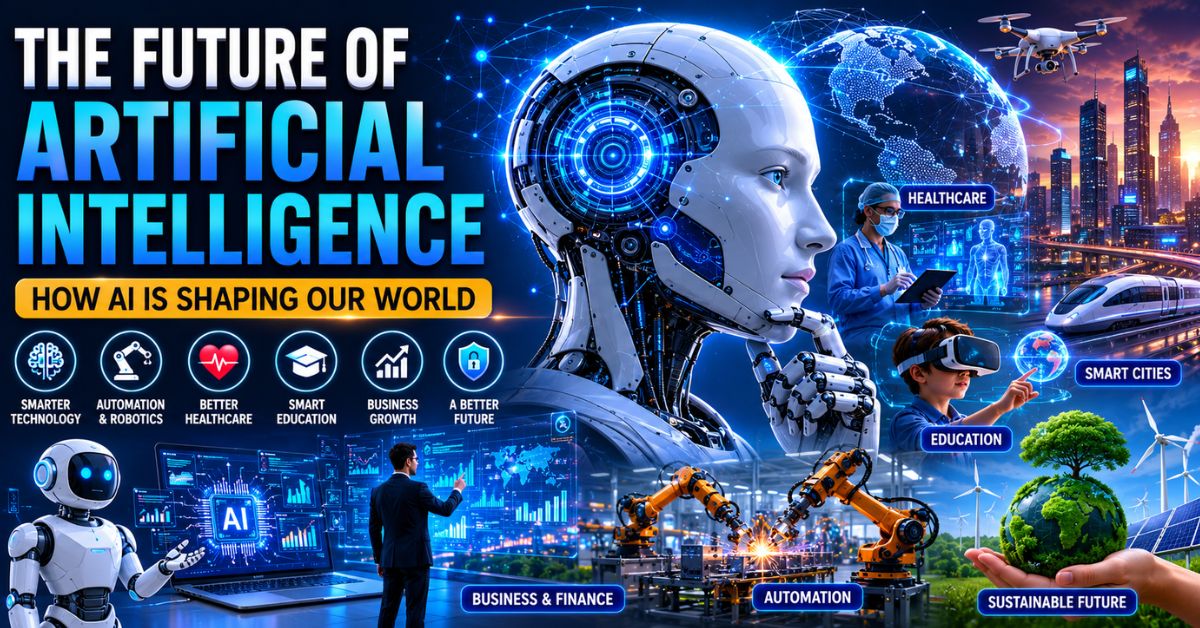
Artificial Intelligence is no longer a futuristic concept—it is already making decisions, solving problems, and transforming industries around us.
From healthcare and education to finance and transportation, AI is changing how we live, work, and interact with technology.
The real question is not whether AI will shape the future. The question is how deeply it will transform every aspect of our lives.
Introduction
Artificial Intelligence (AI) has emerged as one of the most revolutionary technologies of the 21st century. What began as a scientific concept has evolved into a powerful force driving innovation across nearly every industry. Today, AI powers virtual assistants, recommendation systems, autonomous vehicles, medical diagnostics, financial analysis, and countless other applications.
As computing power increases and machine learning algorithms become more sophisticated, AI continues to expand its capabilities. Businesses are investing billions of dollars into AI research and development, governments are creating AI policies, and educational institutions are preparing students for an AI-driven future.
The influence of artificial intelligence extends far beyond technology companies. It is transforming healthcare, reshaping economies, enhancing education, improving customer experiences, and redefining the nature of work itself.
This article explores the future of artificial intelligence, its impact on society, the opportunities it creates, the challenges it presents, and how AI is shaping the world we live in.
What Is Artificial Intelligence?
Artificial Intelligence refers to computer systems designed to perform tasks that typically require human intelligence.
These tasks include:
- Learning from data
- Problem-solving
- Decision-making
- Language understanding
- Visual recognition
- Pattern identification
- Predictive analysis
AI systems use algorithms and large datasets to improve performance over time.
Unlike traditional software that follows fixed instructions, AI can learn, adapt, and make intelligent decisions based on experience.
Types of Artificial Intelligence
Narrow AI
Narrow AI is designed for specific tasks.
Examples include:
- Voice assistants
- Recommendation engines
- Facial recognition systems
- Chatbots
Most AI systems in use today fall into this category.
General AI
General AI refers to machines capable of performing any intellectual task a human can perform.
Although researchers are making progress, General AI remains largely theoretical.
Superintelligent AI
Superintelligent AI would surpass human intelligence across all domains.
While this concept is often discussed, it remains a future possibility rather than a current reality.
Related post: The Role of ICT in Modern Education: How Technology is Transforming Learning
Why AI Matters More Than Ever
Artificial intelligence is becoming increasingly important because of its ability to process vast amounts of information quickly and accurately.
Organizations use AI to:
- Improve efficiency
- Reduce costs
- Enhance decision-making
- Deliver personalized experiences
- Increase productivity
As data continues to grow exponentially, AI helps businesses and institutions extract valuable insights that would be impossible to identify manually.
How AI Is Transforming Industries
AI in Healthcare
Healthcare is experiencing a major transformation through AI-powered solutions.
Early Disease Detection
AI can analyze medical images and patient data to identify diseases earlier than traditional methods.
Applications include:
- Cancer detection
- Heart disease prediction
- Neurological disorder diagnosis
Personalized Treatment Plans
AI helps healthcare providers develop customized treatment strategies based on individual patient data.
Drug Discovery
Researchers use AI to accelerate the development of new medications by analyzing biological data and predicting drug effectiveness.
Virtual Health Assistants
AI-powered assistants help patients:
- Schedule appointments
- Monitor symptoms
- Receive health information
These innovations improve healthcare accessibility and outcomes.
AI in Education
Technology is reshaping education through intelligent learning systems.
Personalized Learning
AI adapts educational content based on student performance and learning styles.
Benefits include:
- Customized instruction
- Improved engagement
- Better learning outcomes
Automated Administrative Tasks
AI assists educators by automating:
- Grading
- Attendance tracking
- Performance analysis
This allows teachers to focus more on student development.
Intelligent Tutoring Systems
AI tutors provide personalized guidance and support outside the classroom.
These systems help students learn at their own pace.
AI in Business and Finance
Businesses increasingly rely on AI to gain competitive advantages.
Data-Driven Decision Making
AI analyzes large datasets to uncover trends and insights that support strategic decisions.
Fraud Detection
Financial institutions use AI to identify suspicious transactions and prevent fraud.
Customer Service Automation
Chatbots and virtual assistants provide:
- 24/7 customer support
- Faster response times
- Improved customer experiences
Predictive Analytics
AI helps businesses forecast:
- Customer behavior
- Market trends
- Sales performance
These insights improve planning and resource allocation.
AI and the Future of Work
One of the most discussed aspects of AI is its impact on employment.
Automation of Repetitive Tasks
AI excels at handling routine and repetitive activities.
Examples include:
- Data entry
- Scheduling
- Inventory management
- Basic customer inquiries
Automation increases efficiency while reducing operational costs.
Creation of New Jobs
Although some jobs may be automated, AI also creates new opportunities.
Emerging roles include:
- AI engineers
- Data scientists
- Machine learning specialists
- AI ethics consultants
- Robotics technicians
Technology has historically created new industries even as it transformed existing ones.
Human-AI Collaboration
The future workplace is likely to involve collaboration between humans and AI systems.
Humans will continue to provide:
- Creativity
- Critical thinking
- Emotional intelligence
- Ethical judgment
AI will augment human capabilities rather than completely replace them.
AI in Transportation
Transportation is undergoing significant changes due to artificial intelligence.
Autonomous Vehicles
Self-driving cars use AI to:
- Interpret road conditions
- Detect obstacles
- Make driving decisions
These technologies have the potential to reduce accidents and improve mobility.
Smart Traffic Management
Cities use AI systems to optimize traffic flow and reduce congestion.
Logistics Optimization
AI helps transportation companies improve:
- Route planning
- Fuel efficiency
- Delivery schedules
This increases operational efficiency and reduces costs.
AI in Smart Cities
Urban environments are becoming increasingly intelligent through AI-powered systems.
Energy Management
AI helps optimize energy consumption by analyzing usage patterns.
Public Safety
Smart surveillance systems can identify potential threats and support emergency response efforts.
Waste Management
AI improves waste collection routes and resource allocation.
These innovations contribute to more sustainable and efficient cities.
Artificial Intelligence and Everyday Life
Many people interact with AI daily without realizing it.
Examples include:
Virtual Assistants
AI powers assistants that can:
- Answer questions
- Set reminders
- Control smart devices
Streaming Recommendations
Platforms use AI to recommend:
- Movies
- Music
- TV shows
based on user preferences.
Online Shopping
AI personalizes product recommendations and enhances customer experiences.
Social Media Algorithms
AI helps determine the content users see on social platforms.
Its influence on daily life continues to expand rapidly.
Emerging AI Technologies Shaping the Future
Generative AI
Generative AI creates:
- Text
- Images
- Videos
- Music
- Software code
This technology is transforming content creation and productivity.
Natural Language Processing
Advancements in language understanding enable AI systems to communicate more naturally with humans.
Applications include:
- Translation services
- Virtual assistants
- Customer support
Computer Vision
AI systems can interpret and analyze visual information.
Applications include:
- Medical imaging
- Security systems
- Autonomous vehicles
Robotics and AI Integration
Combining robotics with AI creates machines capable of performing increasingly complex tasks.
Industries benefiting include:
- Manufacturing
- Healthcare
- Agriculture
- Logistics
Ethical Challenges of Artificial Intelligence
As AI becomes more powerful, ethical concerns continue to grow.
Data Privacy
AI systems often require large amounts of personal data.
Organizations must ensure data is collected and used responsibly.
Algorithmic Bias
AI systems can unintentionally reflect biases present in training data.
This may lead to unfair outcomes in areas such as:
- Hiring
- Lending
- Law enforcement
Transparency
Many AI systems operate as “black boxes.”
Users often do not understand how decisions are made.
Improving transparency is essential for trust and accountability.
Security Risks
Cybercriminals may use AI to create sophisticated attacks.
Organizations must develop stronger security measures to address evolving threats.
The Economic Impact of AI
Artificial intelligence is expected to contribute significantly to global economic growth.
Benefits include:
- Increased productivity
- Enhanced innovation
- Improved efficiency
- New business opportunities
Organizations that successfully adopt AI may gain substantial competitive advantages.
Countries investing heavily in AI research are positioning themselves as future technology leaders.
AI and Environmental Sustainability
AI can help address environmental challenges.
Climate Modeling
AI analyzes climate data to improve forecasting and support environmental planning.
Energy Efficiency
Smart systems optimize energy usage in buildings and industries.
Precision Agriculture
Farmers use AI to:
- Monitor crops
- Reduce resource waste
- Improve yields
These applications contribute to more sustainable practices.
Challenges Facing the Future of AI
Despite its enormous potential, AI faces several challenges.
Regulatory Uncertainty
Governments worldwide are developing policies to govern AI development and use.
Skills Shortages
Demand for AI expertise continues to exceed supply.
Educational institutions must prepare future talent.
Public Trust
Building trust requires transparency, accountability, and ethical practices.
Technological Limitations
Current AI systems still face limitations in reasoning, understanding context, and handling complex real-world situations.
Ongoing research seeks to overcome these barriers.
What the Future of AI Might Look Like
The next decade could bring dramatic changes.
Potential developments include:
- More intelligent virtual assistants
- Advanced healthcare diagnostics
- Fully autonomous transportation systems
- Smarter cities
- Enhanced workplace productivity
- More personalized education
- Greater integration of AI into daily life
AI is expected to become increasingly embedded in society, influencing nearly every aspect of human activity.
How Individuals Can Prepare for an AI-Driven Future
As AI continues to evolve, individuals should focus on developing skills that complement technology.
Important skills include:
- Critical thinking
- Creativity
- Emotional intelligence
- Adaptability
- Digital literacy
- Problem-solving
Continuous learning will be essential in an AI-powered economy.
Those who embrace technology and develop future-ready skills will be best positioned for success.
Conclusion
Artificial Intelligence is rapidly becoming one of the defining technologies of our era. Its impact is already visible across healthcare, education, business, transportation, finance, and countless other sectors. As AI continues to advance, it will unlock new opportunities, solve complex challenges, and reshape how people live and work.
While concerns about ethics, privacy, employment, and regulation remain important, the potential benefits of AI are enormous. The key to maximizing these benefits lies in responsible development, transparent governance, and a commitment to ensuring that AI serves humanity’s best interests.
The future of artificial intelligence is not simply about smarter machines. It is about creating a world where technology enhances human potential, improves quality of life, and drives innovation on a global scale. Those who understand and adapt to this transformation will be better prepared to thrive in the AI-powered future that lies ahead.
Frequently Asked Questions (FAQs)
What is Artificial Intelligence (AI)?
Artificial Intelligence is technology that enables computers and machines to perform tasks that typically require human intelligence, such as learning, problem-solving, and decision-making.
How is AI changing the world?
AI is transforming industries by improving efficiency, automating processes, enhancing decision-making, and creating innovative products and services.
Will AI replace human jobs?
AI may automate some repetitive tasks, but it is also expected to create new jobs and opportunities. Many future workplaces will involve collaboration between humans and AI systems.
What industries benefit most from AI?
Healthcare, education, finance, manufacturing, transportation, retail, agriculture, and customer service are among the industries benefiting significantly from AI.
What are the risks of Artificial Intelligence?
Potential risks include data privacy concerns, algorithmic bias, cybersecurity threats, misinformation, and lack of transparency in decision-making.
What is Generative AI?
Generative AI is a type of AI that can create original content such as text, images, videos, music, and software code.
How does AI help businesses?
AI helps businesses automate tasks, analyze data, improve customer experiences, reduce costs, and make better strategic decisions.
Can AI think like humans?
Current AI systems can simulate certain aspects of human intelligence but do not possess consciousness, emotions, or human-level understanding.
What skills are important in an AI-driven future?
Critical thinking, creativity, adaptability, emotional intelligence, digital literacy, and problem-solving will remain highly valuable.
What is the future of Artificial Intelligence?
The future of AI includes smarter automation, personalized services, advanced healthcare solutions, intelligent transportation systems, and deeper integration into everyday life.