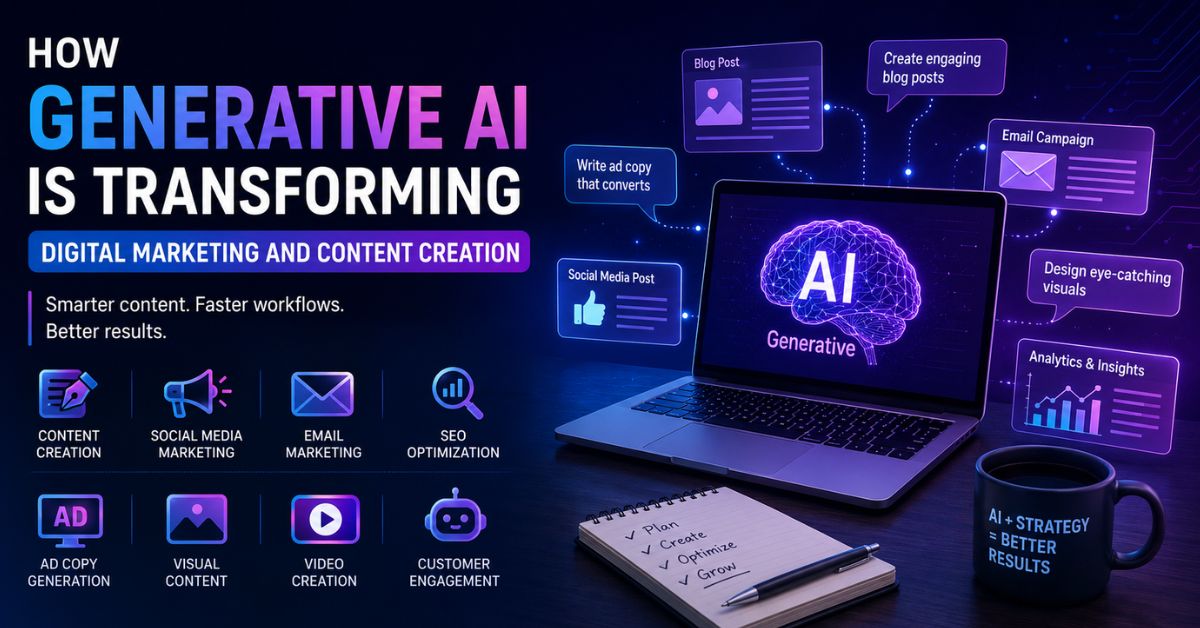
Digital marketing is changing faster than ever, and generative AI is leading the revolution.
Businesses that once spent weeks creating content can now produce campaigns in hours.
From blog posts and social media captions to personalized emails and videos, generative AI is redefining how brands attract and engage customers.
Artificial Intelligence (AI) has evolved from being a futuristic technology into a practical business tool used by companies of all sizes. Among the various forms of AI, Generative AI has emerged as one of the most transformative innovations in recent years.
Unlike traditional AI systems that primarily analyze data and make predictions, generative AI creates entirely new content. It can write articles, generate images, design marketing materials, produce videos, create software code, and even assist in developing complete marketing strategies.
For marketers and content creators, this technology is opening doors to new levels of efficiency, personalization, and creativity. Organizations that adopt generative AI effectively are discovering ways to save time, reduce costs, improve customer experiences, and stay ahead of competitors.
In this comprehensive guide, we’ll explore how generative AI is transforming digital marketing and content creation, its benefits, real-world applications, challenges, and what the future holds.
What Is Generative AI?
Generative AI refers to artificial intelligence systems capable of producing original content by learning patterns from massive datasets.
Instead of simply analyzing information, these systems generate new outputs that resemble human-created work.
Generative AI can create:
- Blog articles
- Social media posts
- Email campaigns
- Images and graphics
- Videos and animations
- Product descriptions
- Marketing strategies
- Website copy
- Software code
- Customer responses
Examples of popular generative AI tools include:
- ChatGPT
- Google Gemini
- Claude
- Midjourney
- DALL·E
- Adobe Firefly
- Jasper AI
- Copy.ai
These tools are rapidly becoming essential components of modern marketing workflows.
Why Generative AI Matters in Digital Marketing
Digital marketing demands a constant flow of fresh, engaging content.
Brands need to create:
- Blog posts
- Social media updates
- Email newsletters
- Advertisements
- Videos
- Landing pages
- Product descriptions
- Customer responses
Producing all this content manually requires substantial time and resources.
Generative AI dramatically changes this process by enabling businesses to create high-quality content faster and more efficiently.
The technology doesn’t necessarily replace marketers. Instead, it enhances human capabilities by automating repetitive tasks and accelerating content production.
The Rise of AI-Powered Content Creation
Content marketing has become one of the most important digital marketing strategies.
Consumers expect brands to consistently deliver valuable information across multiple channels.
However, maintaining this content demand can be challenging.
Generative AI addresses this issue by helping businesses:
- Produce more content in less time
- Maintain consistency
- Personalize customer experiences
- Improve campaign performance
- Scale marketing operations
This shift is fundamentally changing how marketing teams operate.
Related post: Generative AI vs Traditional AI: Key Differences, Benefits, and Real-World Applications
How Generative AI Is Transforming Content Writing
Faster Content Production
Traditional content creation often involves:
- Research
- Planning
- Drafting
- Editing
- Publishing
These activities can take several hours or even days.
Generative AI significantly reduces production time.
Marketers can generate:
- Blog outlines
- Article drafts
- Headlines
- Meta descriptions
- Product descriptions
- Social media posts
This efficiency allows businesses to publish content more frequently and respond quickly to market trends.
Overcoming Writer’s Block
Every content creator experiences creative fatigue.
Coming up with new ideas consistently can be difficult.
Generative AI acts as a brainstorming partner.
It can generate:
- Topic ideas
- Article structures
- Headlines
- Marketing angles
- Call-to-action suggestions
This capability helps creators maintain momentum and productivity.
Content Repurposing at Scale
A single piece of content can be transformed into multiple formats.
For example, one blog article can become:
- Instagram captions
- Facebook posts
- LinkedIn articles
- Email newsletters
- Video scripts
- Infographics
Generative AI automates much of this repurposing process, enabling brands to maximize the value of every content asset.
Revolutionizing Search Engine Optimization (SEO)
Keyword Research Assistance
SEO relies heavily on identifying relevant keywords.
Generative AI tools can:
- Suggest keyword ideas
- Identify long-tail keywords
- Generate related search terms
- Create topic clusters
- Recommend semantic keywords
This speeds up SEO planning and content development.
Optimized Content Creation
Search engines reward useful and relevant content.
Generative AI helps marketers:
- Structure articles effectively
- Create engaging headings
- Improve readability
- Generate meta descriptions
- Produce FAQ sections
When combined with human editing and SEO expertise, AI-generated content can significantly improve search visibility.
Content Gap Analysis
Generative AI can analyze existing content and identify opportunities.
Marketers can discover:
- Missing topics
- Untapped keywords
- Content opportunities
- User search intent gaps
This enables businesses to create more strategic content.
Transforming Social Media Marketing
Faster Social Media Content Creation
Social media requires constant activity.
Brands often struggle to maintain posting consistency.
Generative AI can instantly create:
- Captions
- Tweets
- Facebook posts
- LinkedIn updates
- Instagram descriptions
- Video scripts
This helps businesses maintain an active online presence.
Personalized Engagement
Consumers expect personalized experiences.
Generative AI enables businesses to tailor messages based on:
- Customer interests
- Demographics
- Behaviors
- Purchase history
Personalization increases engagement and strengthens customer relationships.
Real-Time Campaign Adaptation
Marketing trends change rapidly.
Generative AI allows businesses to create and modify campaigns quickly.
Companies can react to:
- Trending topics
- Seasonal events
- Industry developments
- Consumer interests
This agility creates a competitive advantage.
Enhancing Email Marketing
Personalized Email Campaigns
Generic email campaigns often perform poorly.
Generative AI creates:
- Personalized subject lines
- Customized offers
- Individualized recommendations
- Dynamic email content
These improvements can significantly increase:
- Open rates
- Click-through rates
- Customer engagement
- Conversion rates
Automated Email Sequences
Businesses use email sequences for:
- Lead nurturing
- Customer onboarding
- Promotions
- Re-engagement campaigns
Generative AI can draft these sequences quickly while maintaining brand consistency.
Improving Advertising Campaigns
Ad Copy Generation
Writing persuasive advertisements requires creativity and testing.
Generative AI can instantly produce:
- Google Ads copy
- Facebook Ads
- Product promotions
- Video ad scripts
- Display advertisements
Marketers can then refine and test multiple versions.
A/B Testing at Scale
Successful advertising depends on experimentation.
Generative AI enables businesses to generate numerous variations of:
- Headlines
- Descriptions
- Calls to action
- Promotional offers
This increases the likelihood of finding high-performing campaigns.
Transforming Visual Content Creation
AI-Generated Images
Visual content plays a major role in digital marketing.
Generative AI tools can create:
- Blog graphics
- Product images
- Marketing illustrations
- Social media visuals
- Advertising creatives
Businesses can reduce design costs while producing professional-looking assets.
Graphic Design Assistance
Generative AI helps designers by generating:
- Design concepts
- Layout suggestions
- Color combinations
- Creative ideas
Rather than replacing designers, AI enhances productivity and creativity.
Revolutionizing Video Marketing
Video marketing continues to dominate digital platforms.
However, video production can be expensive and time-consuming.
Generative AI simplifies the process by helping create:
- Video scripts
- Voiceovers
- Animations
- Short promotional clips
- Educational videos
This enables businesses of all sizes to leverage video marketing.
Improving Customer Support
AI Chatbots and Virtual Assistants
Customer expectations continue to rise.
Consumers expect immediate responses.
Generative AI powers intelligent chatbots that can:
- Answer questions
- Provide recommendations
- Resolve simple issues
- Guide customers through purchases
These systems improve customer satisfaction while reducing operational costs.
24/7 Availability
Unlike human teams, AI assistants can operate continuously.
Businesses can provide support around the clock without significantly increasing staffing costs.
Real-World Applications of Generative AI in Marketing
E-Commerce
Online stores use generative AI to:
- Create product descriptions
- Recommend products
- Generate promotional content
- Personalize customer experiences
Media Companies
Publishers use AI to:
- Draft articles
- Generate headlines
- Summarize reports
- Create newsletters
Digital Agencies
Marketing agencies leverage AI to:
- Produce campaign ideas
- Create content faster
- Manage multiple clients
- Generate reports
Small Businesses
Small businesses use generative AI to:
- Build websites
- Create advertisements
- Produce social media content
- Improve customer engagement
AI is leveling the playing field by giving smaller organizations access to capabilities once available only to large enterprises.
Benefits of Generative AI in Digital Marketing
Increased Productivity
AI handles repetitive tasks, allowing teams to focus on strategy and creativity.
Lower Costs
Businesses can produce more content without proportionally increasing budgets.
Greater Scalability
Organizations can create content across multiple channels simultaneously.
Enhanced Creativity
AI provides fresh perspectives and ideas that inspire human creators.
Better Personalization
Businesses can deliver tailored experiences to larger audiences.
Faster Time-to-Market
Campaigns can be developed and launched more quickly.
Challenges and Limitations
Despite its benefits, generative AI has limitations.
Accuracy Concerns
AI occasionally produces incorrect information.
Content should always be reviewed by humans.
Lack of Human Emotion
AI can mimic human language but may struggle with emotional nuance and authentic storytelling.
Potential Bias
Training data can contain biases that influence outputs.
Businesses should monitor generated content carefully.
Copyright Issues
Organizations must understand ownership and licensing considerations when using AI-generated content.
Overdependence on Automation
Relying entirely on AI may result in generic content and reduced originality.
Human oversight remains essential.
Best Practices for Using Generative AI in Marketing
Use AI as a Creative Assistant
AI should support creativity rather than replace it.
Fact-Check Generated Content
Always verify statistics, claims, and references.
Maintain Brand Voice
Review AI-generated material to ensure consistency with your brand identity.
Combine Human Creativity and AI Efficiency
The most successful marketing teams use AI for speed while relying on human expertise for strategy and emotional connection.
Stay Ethical
Businesses should prioritize transparency, privacy, and responsible AI practices.
The Future of Generative AI in Digital Marketing
Generative AI is still evolving.
Future developments may include:
Hyper-Personalized Marketing
AI will create experiences tailored to individual customer preferences in real time.
Autonomous Marketing Systems
Campaign planning, content creation, and optimization may become increasingly automated.
Advanced Video and Multimedia Creation
AI-generated videos, animations, and interactive experiences will continue improving.
Predictive Content Strategies
AI may predict emerging trends and recommend content opportunities before competitors identify them.
Deeper Human-AI Collaboration
Rather than replacing marketers, AI will increasingly act as an intelligent assistant that enhances creativity and productivity.
Organizations that embrace these innovations responsibly will gain significant competitive advantages.
Conclusion
Generative AI is transforming digital marketing and content creation at an extraordinary pace. From writing articles and generating social media content to creating images, videos, and personalized customer experiences, the technology is reshaping how businesses communicate with their audiences.
The greatest strength of generative AI lies in its ability to increase efficiency, reduce costs, and scale content production without sacrificing creativity. However, successful implementation requires balance. Human oversight remains essential for ensuring accuracy, emotional authenticity, strategic thinking, and ethical responsibility.
Businesses that view generative AI as a collaborative partner rather than a replacement for human talent are likely to achieve the best results. As AI capabilities continue advancing, marketers who learn to leverage these tools effectively will be better positioned to engage customers, improve performance, and stay competitive in an increasingly digital world.
Frequently Asked Questions (FAQs)
What is generative AI in digital marketing?
Generative AI refers to artificial intelligence systems that create original content such as articles, advertisements, emails, images, and videos to support marketing activities.
How does generative AI improve content creation?
It speeds up content production, generates ideas, automates repetitive tasks, and enables businesses to create more content efficiently.
Can generative AI replace content writers?
No. Generative AI is best used as an assistant that enhances productivity. Human writers remain essential for strategy, creativity, editing, and emotional storytelling.
Is AI-generated content good for SEO?
Yes. When properly edited and optimized, AI-generated content can improve SEO performance by helping businesses create relevant, high-quality content consistently.
What industries benefit from generative AI?
Industries including e-commerce, education, media, healthcare, finance, software development, and digital marketing benefit significantly from generative AI technologies.
What are the risks of using generative AI?
Risks include inaccurate information, potential bias, copyright concerns, and overreliance on automation. Human review and responsible implementation help minimize these challenges.
Is generative AI suitable for small businesses?
Absolutely. Generative AI enables small businesses to create professional marketing content, improve customer engagement, and compete more effectively without large marketing budgets.