Artificial intelligence is changing everything—but not all AI works the same way.
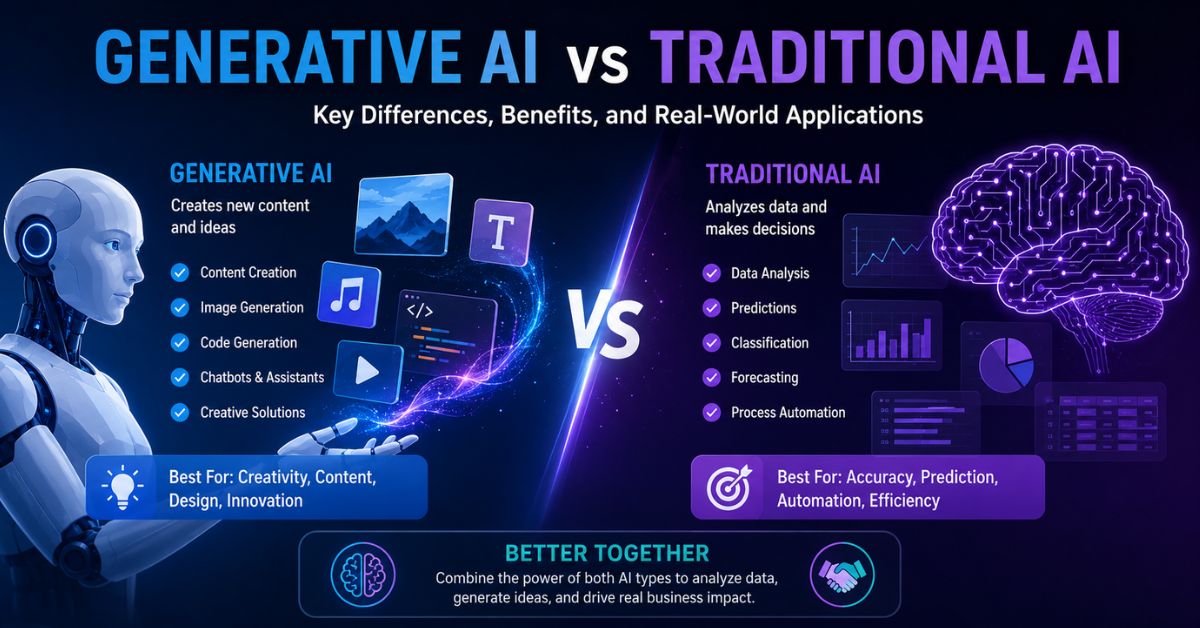
Generative AI can create content from scratch, while traditional AI focuses on analyzing data and making decisions.
Understanding this difference could save your business thousands of dollars and help you choose the right AI solution.
Artificial Intelligence (AI) has evolved from a futuristic concept into one of the most valuable technologies in business, healthcare, education, finance, marketing, and manufacturing. Over the past decade, traditional AI has helped organizations automate repetitive tasks, improve decision-making, and predict outcomes using historical data.
Then came Generative AI, a revolutionary advancement capable of creating text, images, videos, music, software code, and even business strategies.
Many people assume Generative AI simply replaces Traditional AI. That isn’t true.
Instead, these technologies serve different purposes and often work together.
In this guide, you’ll learn:
- What Traditional AI is
- What Generative AI is
- The biggest differences between them
- Advantages and disadvantages
- Real-world applications
- Which AI is best for different industries
- The future of AI in business
Let’s dive in.
What Is Traditional AI?
Traditional AI refers to artificial intelligence systems designed to analyze information, identify patterns, make predictions, classify data, and automate decisions based on predefined rules or trained machine learning models.
Rather than creating something entirely new, traditional AI focuses on solving specific problems accurately.
Its primary goal is making intelligent decisions.
Examples include:
- Email spam filters
- Fraud detection systems
- Credit scoring
- Product recommendation engines
- Voice recognition
- Navigation systems
- Medical diagnosis support
Traditional AI relies heavily on structured datasets.
The more quality data it receives, the more accurate its predictions become.
How Traditional AI Works
Traditional AI typically follows these steps:
Collect Data
Historical information is gathered from databases, sensors, transactions, or user behavior.
Train Machine Learning Models
Algorithms learn patterns from historical data.
Examples include:
- Decision Trees
- Random Forest
- Support Vector Machines
- Logistic Regression
- Neural Networks
Predict Outcomes
Once trained, the AI predicts future events or classifies new data.
Examples include:
- Will a customer cancel a subscription?
- Is this transaction fraudulent?
- Will equipment fail soon?
Continuous Improvement
Models improve as new data becomes available.
What Is Generative AI?
Generative AI is a branch of artificial intelligence designed to create entirely new content rather than simply analyze existing information.
Instead of predicting whether something belongs to a category, it generates something original.
Examples include:
- Articles
- Emails
- Images
- Videos
- Music
- Computer code
- Product designs
- Marketing campaigns
- Chatbots
- Virtual assistants
Generative AI learns patterns from enormous datasets and then uses those patterns to generate new outputs that resemble human-created work.
How Generative AI Works
Generative AI typically uses advanced neural networks known as foundation models.
These models are trained on billions of examples.
Instead of memorizing information, they learn relationships between words, images, sounds, or code.
When prompted, they predict what should come next.
For example:
Prompt:
Write a professional resignation letter.
The AI predicts each next word until a complete letter is produced.
The same concept applies to images.
Prompt:
A futuristic smart city at sunset.
The AI generates an entirely new image.
Evolution of Artificial Intelligence
Understanding AI’s evolution makes the difference between these technologies much clearer.
Rule-Based AI
Early AI relied on predefined rules.
Example:
IF customer age > 18
THEN approve account.
These systems were rigid.
Machine Learning
Machine learning allowed computers to learn from data instead of relying solely on rules.
Applications expanded into:
- Banking
- Healthcare
- Retail
- Insurance
Deep Learning
Deep neural networks improved image recognition, speech recognition, and natural language understanding.
Generative AI
Today’s AI can create original content that closely resembles human work.
This represents one of the biggest technological shifts since the internet.
Generative AI vs Traditional AI: Key Differences
| Feature | Traditional AI | Generative AI |
| Primary Purpose | Analyze data | Create new content |
| Output | Predictions and decisions | Text, images, videos, music, code |
| Learning Method | Historical datasets | Massive foundation models |
| Creativity | Limited | High |
| Data Requirements | Structured data | Structured and unstructured data |
| Human Interaction | Usually limited | Highly conversational |
| Applications | Fraud detection, forecasting | Content creation, design, coding |
| Decision Making | Strong | Moderate |
| Personalization | Moderate | Excellent |
| Automation | Task automation | Creative automation |
Traditional AI Examples
Fraud Detection
Banks analyze millions of transactions every second.
Traditional AI identifies suspicious behavior immediately.
Recommendation Systems
Streaming platforms recommend movies based on viewing history.
Online stores recommend products based on browsing behavior.
Medical Diagnosis
Hospitals use AI to detect diseases from scans and laboratory results.
Doctors receive decision support, not replacement.
Predictive Maintenance
Manufacturers predict equipment failures before breakdowns occur.
This reduces downtime and maintenance costs.
Customer Segmentation
Businesses classify customers into groups based on buying behavior.
Marketing becomes more targeted.
Generative AI Examples
Content Writing
Businesses generate:
- Blog posts
- Emails
- Product descriptions
- Social media captions
Image Creation
Marketing teams generate:
- Advertisements
- Product mockups
- Brand illustrations
- Website graphics
Software Development
Developers use AI to:
- Generate code
- Debug software
- Explain programming concepts
- Create documentation
Customer Support
AI chatbots answer customer questions naturally.
Unlike traditional bots, they understand conversational context.
Video Production
Businesses create:
- Explainer videos
- Marketing videos
- Product demonstrations
- Training materials
Benefits of Traditional AI
High Accuracy
Traditional AI performs exceptionally well in narrow, specialized tasks.
Reliable Predictions
Organizations rely on AI forecasts for strategic planning.
Cost Savings
Automation reduces labor costs.
Risk Reduction
Banks detect fraud before money is stolen.
Hospitals identify diseases earlier.
Factories prevent equipment failure.
Better Decision Making
Executives receive data-driven insights.
Benefits of Generative AI
Faster Content Creation
Marketing campaigns that once required weeks can now be developed in hours.
Increased Productivity
Employees spend less time on repetitive creative tasks.
Better Customer Experiences
AI delivers personalized conversations and recommendations.
Innovation
Businesses rapidly test ideas, concepts, and product designs.
Lower Operational Costs
Companies reduce outsourcing expenses for routine creative work.
Limitations of Traditional AI
Despite its strengths, traditional AI has limitations.
Limited Creativity
It cannot invent original ideas.
Data Dependency
Performance depends on high-quality historical data.
Narrow Intelligence
Most models solve only one task.
Limited Adaptability
Retraining is often required when business conditions change.
Limitations of Generative AI
Generative AI also has challenges.
Hallucinations
AI sometimes generates incorrect information confidently.
Bias
Training data may contain bias.
Copyright Concerns
Businesses must verify ownership and licensing of generated content.
Privacy Risks
Sensitive information should never be entered into unsecured AI systems.
Human Review Required
Generated content still requires editing and fact-checking.
Industries Using Traditional AI
Banking
- Credit scoring
- Fraud detection
- Risk management
Healthcare
- Disease prediction
- Medical imaging
- Patient monitoring
Retail
- Inventory management
- Demand forecasting
Manufacturing
- Predictive maintenance
- Quality inspection
Logistics
- Route optimization
- Delivery forecasting
Industries Using Generative AI
Marketing
Generate:
- Ads
- Landing pages
- SEO articles
- Email campaigns
Education
Create:
- Lesson plans
- Quizzes
- Study materials
Entertainment
Produce:
- Music
- Scripts
- Animation
- Games
Software
Generate:
- Source code
- Documentation
- APIs
Design
Create:
- Logos
- Illustrations
- Mockups
- Product concepts
Can Businesses Use Both?
Absolutely.
The smartest organizations combine both technologies.
Example:
Traditional AI predicts which customers are likely to leave.
Generative AI writes personalized emails to retain those customers.
Together they improve:
- Sales
- Customer service
- Marketing
- Productivity
Rather than competing, they complement each other.
Which AI Is Better?
The answer depends on your goals.
Choose Traditional AI if you need:
- Predictions
- Classification
- Fraud detection
- Forecasting
- Risk analysis
- Process automation
Choose Generative AI if you need:
- Content creation
- Design
- Coding assistance
- Marketing materials
- Customer conversations
- Creative brainstorming
Most modern organizations benefit from using both.
Future of Artificial Intelligence
The next generation of AI will combine reasoning, creativity, automation, and real-time decision-making.
Businesses can expect:
- More intelligent virtual assistants
- Autonomous business workflows
- AI-powered software development
- Hyper-personalized customer experiences
- Faster scientific research
- Better healthcare diagnostics
- Smarter manufacturing
Rather than replacing humans entirely, AI will increasingly act as a collaborative partner, handling repetitive work while people focus on strategy, creativity, ethics, and relationship building.
Organizations that invest in AI literacy and responsible implementation today will be better positioned to compete in the years ahead.
Related post: Best Generative AI Tools for Businesses in 2026: Features, Pricing, and ROI
Best Practices for Adopting AI
To maximize the value of AI while minimizing risks, businesses should follow these best practices:
Define Clear Objectives
Start with a specific business problem rather than adopting AI simply because it is popular.
Prioritize Data Quality
Whether using traditional AI or generative AI, high-quality data leads to better outcomes.
Keep Humans in the Loop
AI should support decision-making, not replace critical human judgment in high-risk situations.
Monitor Performance
Regularly evaluate AI outputs for accuracy, fairness, and relevance.
Protect Privacy
Implement strong data governance policies and avoid exposing sensitive information to unauthorized systems.
Train Employees
Provide ongoing education so teams understand how to use AI effectively and responsibly.
Conclusion
Artificial intelligence is no longer a technology reserved for large corporations—it is becoming an essential tool for businesses of every size. While Traditional AI excels at analyzing data, identifying patterns, and making accurate predictions, Generative AI unlocks new possibilities by creating original content, accelerating workflows, and enhancing creativity.
The choice between the two isn’t about determining which technology is superior. It’s about understanding which one aligns with your objectives. If your organization needs forecasting, fraud detection, or operational efficiency, traditional AI remains indispensable. If your focus is content creation, customer engagement, software development, or innovation, generative AI offers remarkable advantages.
The most successful businesses in 2026 and beyond will not choose one over the other—they will combine both technologies to improve productivity, reduce costs, deliver better customer experiences, and drive long-term growth. By embracing AI thoughtfully and responsibly, organizations can stay competitive in an increasingly digital world.
Frequently Asked Questions (FAQs)
Is Generative AI replacing Traditional AI?
No. Generative AI complements Traditional AI rather than replacing it. Traditional AI remains the preferred choice for predictive analytics, classification, and decision-making, while Generative AI focuses on creating new content.
Which industries benefit most from Traditional AI?
Industries such as banking, healthcare, insurance, manufacturing, logistics, and retail rely heavily on Traditional AI for forecasting, fraud detection, predictive maintenance, and operational optimization.
Is Generative AI suitable for small businesses?
Yes. Small businesses can use Generative AI to create marketing content, automate customer support, draft emails, generate product descriptions, and streamline day-to-day operations without large investments.
Can businesses combine Generative AI and Traditional AI?
Absolutely. Many organizations use Traditional AI to analyze customer behavior or predict trends and then use Generative AI to create personalized marketing messages, reports, or recommendations based on those insights.
Which AI is more accurate?
For structured tasks involving predictions or classifications, Traditional AI is generally more accurate. For creative tasks, Generative AI excels but still requires human review to ensure factual accuracy and quality.
Is Generative AI safe to use?
Generative AI is generally safe when used responsibly. Businesses should implement privacy safeguards, verify AI-generated content, and establish policies to ensure ethical and secure use.
What skills are needed to work with AI?
Professionals should develop skills in data literacy, prompt engineering, critical thinking, AI ethics, and domain expertise. Understanding how to interpret AI outputs is becoming increasingly valuable across industries.
What is the future of AI?
The future points toward AI systems that integrate prediction, reasoning, creativity, and automation. Businesses will increasingly use AI as a collaborative tool to enhance productivity, improve customer experiences, and accelerate innovation while maintaining human oversight.