Businesses that fail to adopt AI in 2026 won’t just fall behind—they risk becoming irrelevant.
Generative AI is no longer an experimental technology. It’s now a competitive advantage driving revenue, productivity, and innovation.
The companies growing fastest today are using AI to create content, automate workflows, improve customer service, and make smarter decisions at scale.
Generative AI has evolved from a fascinating innovation into a critical business tool. What began with AI-powered chatbots and content generators has transformed into a powerful ecosystem of intelligent platforms capable of handling everything from marketing and software development to customer support, data analysis, research, and business automation.
In 2026, organizations of all sizes—from startups to global enterprises—are investing heavily in generative AI solutions to reduce operational costs, increase efficiency, and unlock new growth opportunities.
But with hundreds of AI platforms available, choosing the right solution can be overwhelming.
Which AI tool offers the best value?
Which platform delivers measurable ROI?
Which solution fits your business needs and budget?
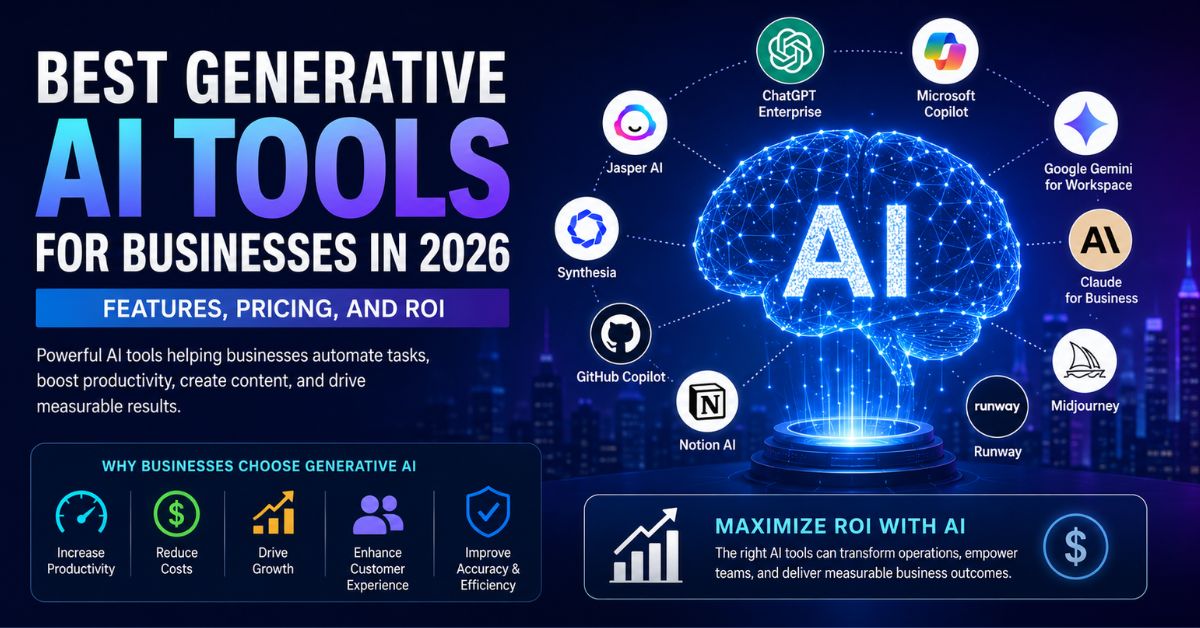
This comprehensive guide explores the best generative AI tools for businesses in 2026, including their key features, pricing models, ideal use cases, advantages, limitations, and expected return on investment.
What Is Generative AI?
Generative AI refers to artificial intelligence systems capable of creating new content, ideas, code, images, videos, audio, and business insights based on user prompts and existing data.
Unlike traditional software that follows predefined rules, generative AI learns patterns and generates original outputs that closely resemble human-created work.
Businesses use generative AI to:
- Create marketing content
- Automate customer support
- Generate reports
- Build software applications
- Design graphics
- Analyze large datasets
- Improve employee productivity
- Accelerate decision-making
As AI models become more sophisticated, businesses are discovering new ways to integrate them into everyday operations.
Why Businesses Are Investing Heavily in Generative AI
The adoption of generative AI is accelerating because the benefits are measurable.
Increased Productivity
AI eliminates repetitive tasks and allows employees to focus on higher-value activities.
Reduced Operational Costs
Organizations can automate processes that previously required significant human effort.
Faster Decision-Making
AI can process and analyze large amounts of information in seconds.
Enhanced Customer Experience
Businesses can provide personalized support and faster responses around the clock.
Competitive Advantage
Companies leveraging AI effectively can innovate faster than competitors.
The combination of these benefits creates a compelling business case for AI investment.
Key Factors to Consider Before Choosing an AI Tool
Before selecting a generative AI platform, businesses should evaluate several critical factors.
Ease of Use
Employees should be able to adopt the tool without extensive training.
Security and Compliance
Enterprise-grade security is essential, especially for industries handling sensitive information.
Integration Capabilities
The AI solution should connect seamlessly with existing software and workflows.
Scalability
Businesses need platforms capable of growing alongside organizational demands.
Pricing Structure
Costs should align with expected business outcomes and ROI.
Customization Options
Different industries require different AI capabilities.
Choosing the right solution requires balancing features, budget, and long-term business goals.
Related post: Generative AI in Business: How Companies Are Using AI to Increase Productivity and Reduce Costs
1. ChatGPT Enterprise
ChatGPT Enterprise remains one of the most powerful generative AI platforms available to businesses in 2026.
Built for enterprise use, it combines advanced conversational AI with security, collaboration, and productivity features.
Key Features
- Advanced content generation
- Business research assistance
- Data analysis capabilities
- Coding support
- Custom AI assistants
- Enterprise-grade security
- Team collaboration tools
Ideal For
- Marketing teams
- Sales departments
- Customer support
- Software development
- Business operations
Pricing
Pricing varies based on organizational requirements and team size.
Enterprise plans typically involve custom pricing.
ROI Potential
Businesses frequently report:
- Faster content creation
- Reduced research time
- Improved employee productivity
- Lower operational costs
ROI is often achieved within the first few months of implementation.
2. Microsoft Copilot
Microsoft Copilot has become deeply integrated into the Microsoft ecosystem, making it an attractive choice for businesses already using Microsoft products.
Key Features
- AI-powered document creation
- Excel analysis automation
- Presentation generation
- Meeting summaries
- Workflow automation
Ideal For
- Enterprises using Microsoft 365
- Financial teams
- Administrative departments
- Project managers
Pricing
Typically offered as an add-on to Microsoft business subscriptions.
ROI Potential
Organizations save significant time on administrative work and document management.
Many businesses report productivity gains exceeding 25%.
3. Google Gemini for Workspace
Google Gemini continues to expand its enterprise capabilities through integration with Google Workspace.
Key Features
- Smart document drafting
- AI-powered email generation
- Spreadsheet analysis
- Meeting note generation
- Research assistance
Ideal For
- Remote teams
- Digital businesses
- Educational institutions
- Marketing agencies
Pricing
Available through various Workspace subscription tiers.
ROI Potential
Gemini helps teams create content faster while improving collaboration across departments.
4. Claude for Business
Claude has become a preferred choice for organizations requiring advanced reasoning, long-context analysis, and document processing.
Key Features
- Large document analysis
- Research assistance
- Content generation
- Policy review
- Knowledge management
Ideal For
- Legal firms
- Consultants
- Research organizations
- Financial institutions
Pricing
Business plans vary based on usage requirements.
ROI Potential
Organizations handling large volumes of documentation often see substantial productivity improvements.
5. Jasper AI
Jasper remains one of the leading AI tools for marketing teams.
Key Features
- Blog generation
- Advertising copy creation
- Social media content
- Brand voice customization
- SEO optimization
Ideal For
- Content marketers
- Agencies
- E-commerce businesses
- Small businesses
Pricing
Subscription-based plans designed for teams and enterprises.
ROI Potential
Jasper significantly reduces content production costs while increasing publishing frequency.
6. Midjourney
Visual content has become increasingly important for businesses.
Midjourney excels in AI-powered image generation.
Key Features
- High-quality image creation
- Brand concept development
- Marketing visuals
- Product mockups
- Creative design support
Ideal For
- Marketing teams
- Designers
- Creative agencies
- E-commerce brands
Pricing
Monthly subscription plans.
ROI Potential
Businesses can reduce design costs and accelerate creative production.
7. Synthesia
Video content continues to dominate digital marketing.
Synthesia allows businesses to create professional videos without cameras, actors, or studios.
Key Features
- AI avatars
- Multilingual video creation
- Training videos
- Product demonstrations
- Corporate communication videos
Ideal For
- HR departments
- Training teams
- Marketing professionals
- Global organizations
Pricing
Multiple subscription levels based on video production requirements.
ROI Potential
Companies save thousands of dollars on traditional video production.
8. GitHub Copilot
Software development teams increasingly rely on AI coding assistants.
GitHub Copilot remains a market leader.
Key Features
- Code suggestions
- Bug detection
- Code completion
- Documentation assistance
- Development acceleration
Ideal For
- Developers
- Software companies
- IT teams
Pricing
Available through individual and enterprise subscriptions.
ROI Potential
Development teams frequently report coding speed improvements of 30% to 50%.
9. Notion AI
Knowledge management has become a major business challenge.
Notion AI combines productivity tools with generative AI capabilities.
Key Features
- Meeting summaries
- Content generation
- Knowledge organization
- Project planning
- Team collaboration
Ideal For
- Startups
- Remote teams
- Project managers
Pricing
Available as an add-on within Notion subscriptions.
ROI Potential
Teams spend less time searching for information and managing documentation.
10. Runway
Runway is revolutionizing video editing and AI-generated media production.
Key Features
- AI video generation
- Video editing automation
- Motion graphics
- Visual effects
- Content creation tools
Ideal For
- Media companies
- Marketing agencies
- Content creators
Pricing
Subscription-based plans.
ROI Potential
Businesses dramatically reduce video production timelines.
Comparing the Best Generative AI Tools in 2026
| Tool | Best For | ROI Potential | Difficulty Level |
| ChatGPT Enterprise | General business use | Very High | Easy |
| Microsoft Copilot | Productivity | High | Easy |
| Google Gemini | Collaboration | High | Easy |
| Claude | Research | High | Easy |
| Jasper | Marketing | Very High | Easy |
| Midjourney | Design | High | Medium |
| Synthesia | Video creation | Very High | Easy |
| GitHub Copilot | Development | Very High | Medium |
| Notion AI | Knowledge management | High | Easy |
| Runway | Video production | High | Medium |
How to Measure Generative AI ROI
Many organizations struggle to quantify AI returns.
The most effective metrics include:
Time Savings
Measure hours saved through automation.
Cost Reduction
Compare labor costs before and after implementation.
Revenue Growth
Track increases in sales and customer acquisition.
Employee Productivity
Evaluate output improvements across teams.
Customer Satisfaction
Monitor support response times and customer feedback.
Operational Efficiency
Assess process improvements and workflow optimization.
Businesses that establish clear KPIs typically achieve better AI outcomes.
Common Mistakes Businesses Make When Adopting AI
Chasing Trends Instead of Objectives
AI should solve real business problems.
Ignoring Employee Training
Even the best AI tools require proper onboarding.
Overlooking Security
Sensitive business data must remain protected.
Unrealistic Expectations
AI enhances human capabilities—it does not replace strategic thinking.
Failing to Measure Results
Without metrics, ROI becomes difficult to evaluate.
Avoiding these mistakes increases the likelihood of successful implementation.
Future Trends in Generative AI for Businesses
Several developments are expected to shape the next phase of AI adoption.
AI Agents
Autonomous AI systems capable of completing multi-step business tasks.
Hyper-Personalization
AI-driven customer experiences tailored to individual preferences.
Industry-Specific AI Models
Specialized solutions designed for healthcare, finance, manufacturing, and legal sectors.
Multimodal AI
Platforms capable of processing text, images, video, audio, and data simultaneously.
AI-Powered Decision Intelligence
Systems that provide strategic recommendations based on real-time analysis.
Businesses that embrace these innovations early may gain significant competitive advantages.
How to Choose the Right AI Tool for Your Business
The best AI platform depends on your objectives.
If your focus is content marketing, Jasper may be ideal.
If productivity is the priority, Microsoft Copilot or ChatGPT Enterprise could deliver stronger results.
For software development, GitHub Copilot remains a top choice.
Organizations should begin by identifying their biggest operational bottlenecks and selecting tools that directly address those challenges.
Starting small, measuring results, and scaling gradually often produces the best outcomes.
Conclusion
Generative AI has become one of the most transformative business technologies of the modern era. In 2026, organizations are no longer asking whether they should adopt AI—they are deciding which AI tools will generate the greatest return on investment.
From ChatGPT Enterprise and Microsoft Copilot to Jasper, Synthesia, GitHub Copilot, and Midjourney, today’s AI ecosystem offers solutions for nearly every business function. These platforms help organizations reduce costs, improve efficiency, enhance customer experiences, and unlock entirely new opportunities for growth.
The businesses that thrive in the coming years will be those that strategically integrate AI into their operations, empower employees to use it effectively, and continuously measure performance improvements. Generative AI is not simply a productivity tool; it is becoming a foundational component of modern business success.
Frequently Asked Questions (FAQs)
What is the best generative AI tool for businesses in 2026?
ChatGPT Enterprise, Microsoft Copilot, and Google Gemini are among the leading choices due to their versatility, scalability, and business-focused features.
Which AI tool offers the highest ROI?
ROI depends on use cases, but ChatGPT Enterprise, Jasper, GitHub Copilot, and Synthesia frequently deliver substantial returns through productivity gains and cost reductions.
Are generative AI tools suitable for small businesses?
Yes. Many AI platforms offer affordable plans designed specifically for startups and small businesses.
How much do business AI tools cost?
Pricing ranges from free plans and low-cost subscriptions to enterprise solutions with custom pricing based on usage and team size.
Can AI replace employees?
AI is best viewed as a productivity enhancer rather than a replacement. It automates repetitive tasks while allowing employees to focus on strategic work.
Which AI tool is best for content marketing?
Jasper and ChatGPT Enterprise are among the strongest options for content creation and marketing workflows.
What is the best AI tool for software developers?
GitHub Copilot remains one of the most popular AI coding assistants for developers.
Are generative AI tools secure?
Most leading providers offer enterprise-grade security, compliance features, and data protection measures.
How long does it take to see ROI from AI?
Many businesses begin seeing measurable productivity gains within weeks or months of implementation.
What is the future of generative AI in business?
The future includes AI agents, multimodal systems, advanced automation, industry-specific models, and deeper integration across business operations.