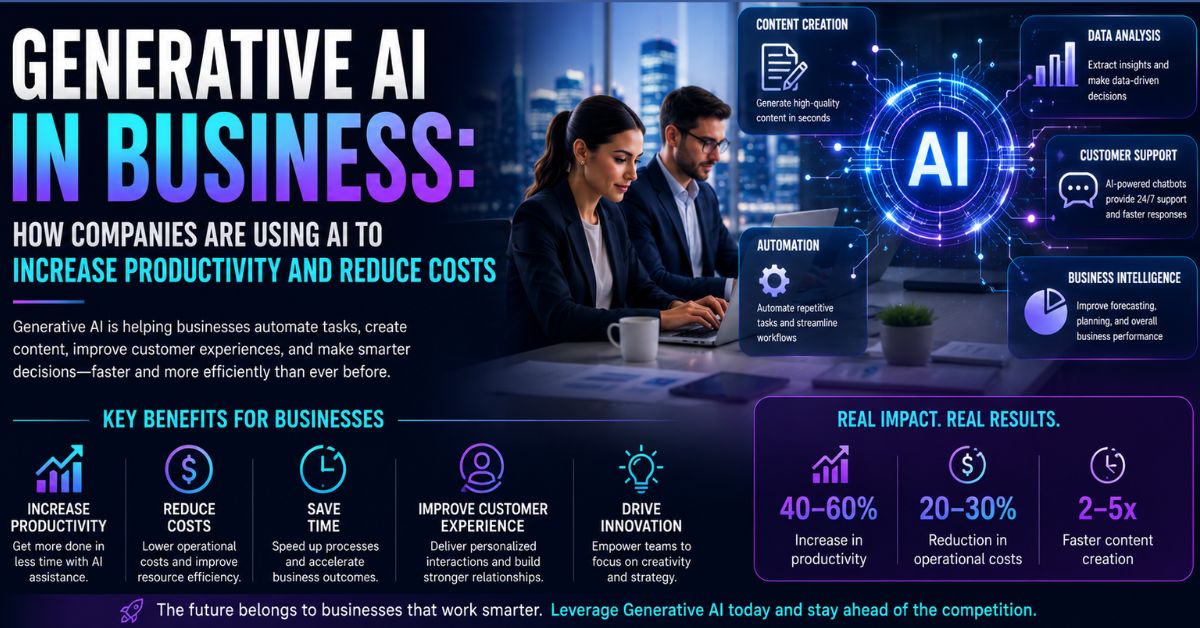
Companies that ignore Generative AI today may find themselves struggling to compete tomorrow.
Businesses are using AI to complete tasks in minutes that once took teams hours or even days.
The result is higher productivity, lower operating costs, and a significant competitive advantage.
Introduction
Generative Artificial Intelligence (Generative AI) is rapidly transforming the business landscape. Once considered an emerging technology, it has become a practical tool that organizations use to automate processes, improve decision-making, enhance customer experiences, and reduce operational expenses.
From creating marketing content and analyzing data to generating software code and improving customer support, Generative AI is helping companies work smarter and faster. Businesses across industries are discovering that AI can handle repetitive tasks, streamline workflows, and support employees in ways that increase efficiency without sacrificing quality.
The growing adoption of Generative AI is not simply about replacing manual work. It is about empowering teams to focus on higher-value activities such as strategy, innovation, creativity, and customer engagement. Organizations that effectively integrate AI into their operations are often able to achieve more with fewer resources while maintaining a competitive edge in increasingly digital markets.
This article explores how Generative AI is being used in business, the benefits it offers, the challenges organizations face, and the future opportunities that AI presents for companies seeking growth and efficiency.
What Is Generative AI?
Generative AI refers to artificial intelligence systems capable of creating new content based on patterns learned from existing data.
Unlike traditional AI systems that focus primarily on analysis and prediction, Generative AI can produce:
- Text
- Images
- Videos
- Audio
- Software code
- Business reports
- Marketing content
- Product designs
These systems use advanced machine learning models to generate human-like outputs quickly and accurately.
Popular applications include:
- AI writing assistants
- Chatbots
- Image generators
- Coding assistants
- Virtual agents
Generative AI is becoming one of the most powerful productivity tools available to modern businesses.
Why Businesses Are Investing in Generative AI
Organizations are investing heavily in AI because it delivers measurable business value.
Key drivers include:
- Increased productivity
- Reduced operational costs
- Faster decision-making
- Improved customer experiences
- Enhanced innovation
- Better resource utilization
As competition increases, businesses are seeking technologies that enable them to do more with less.
Generative AI provides exactly that opportunity.
Related post: The Future of Artificial Intelligence: How AI is Shaping Our World
How Generative AI Improves Productivity
Automating Repetitive Tasks
One of the biggest advantages of Generative AI is automation.
Many employees spend significant time on repetitive activities such as:
- Writing emails
- Preparing reports
- Creating presentations
- Summarizing documents
- Managing schedules
AI can complete many of these tasks within seconds.
This allows employees to focus on strategic and creative responsibilities that generate greater business value.
Accelerating Content Creation
Content creation is often time-consuming.
Businesses need content for:
- Websites
- Blogs
- Social media
- Product descriptions
- Email campaigns
- Advertising
Generative AI helps create first drafts quickly, reducing production time and increasing output.
Marketing teams can generate more content without significantly increasing costs.
Improving Research and Information Retrieval
Employees frequently spend hours searching for information.
AI-powered tools can:
- Analyze large datasets
- Summarize research
- Extract key insights
- Generate reports
This speeds up decision-making and improves workplace efficiency.
Supporting Employee Productivity
AI acts as a digital assistant that helps employees complete tasks faster.
Examples include:
- Drafting communications
- Organizing information
- Generating ideas
- Answering internal questions
Workers can achieve more within the same amount of time.
How Generative AI Helps Reduce Business Costs
Lower Labor Costs for Routine Tasks
Generative AI can handle many repetitive functions traditionally performed manually.
Examples include:
- Customer support inquiries
- Data entry assistance
- Documentation generation
- Administrative tasks
Businesses can reduce operational expenses while maintaining productivity.
Reducing Marketing Expenses
Content marketing often requires significant investments in:
- Writers
- Designers
- Editors
AI tools help streamline content production, reducing costs associated with routine creative work.
Human oversight remains important, but AI significantly lowers production expenses.
Improving Operational Efficiency
Efficiency improvements lead directly to cost savings.
AI helps organizations:
- Eliminate bottlenecks
- Reduce delays
- Optimize workflows
- Improve resource allocation
The result is lower operating costs and better performance.
Minimizing Human Errors
Errors can be expensive.
Mistakes in documentation, communication, and data processing may lead to:
- Financial losses
- Customer dissatisfaction
- Compliance issues
AI systems help improve consistency and accuracy.
Generative AI Applications Across Business Functions
Marketing and Advertising
Marketing is one of the fastest-growing areas of AI adoption.
Businesses use AI to:
Create Marketing Content
AI generates:
- Blog articles
- Social media posts
- Product descriptions
- Ad copy
- Email campaigns
Personalize Customer Experiences
AI analyzes customer behavior and creates personalized recommendations.
This improves engagement and conversion rates.
Optimize Advertising Campaigns
AI can identify:
- High-performing content
- Audience segments
- Campaign opportunities
This improves marketing ROI.
Generative AI in Customer Service
Customer expectations continue to rise.
Businesses must provide fast, accurate, and personalized support.
AI-Powered Chatbots
Modern chatbots can:
- Answer common questions
- Resolve simple issues
- Provide product information
- Handle customer requests
Support becomes available 24/7.
Virtual Customer Assistants
Advanced AI assistants can engage in natural conversations and provide personalized recommendations.
This improves customer satisfaction while reducing support costs.
Generative AI in Human Resources
HR departments are increasingly using AI to streamline processes.
Recruitment Support
AI can:
- Screen resumes
- Draft job descriptions
- Identify qualified candidates
Recruiters save time and focus on strategic hiring decisions.
Employee Training
AI creates:
- Training materials
- Learning resources
- Personalized learning experiences
This improves workforce development.
Internal Knowledge Management
Employees can quickly access company information through AI-powered knowledge systems.
Generative AI in Software Development
Software development is being transformed by AI-powered coding assistants.
Code Generation
AI can generate code snippets, templates, and even complete functions.
Benefits include:
- Faster development
- Increased productivity
- Reduced coding effort
Debugging Assistance
AI helps developers:
- Identify errors
- Suggest fixes
- Improve code quality
This reduces development time.
Documentation Creation
AI automatically generates technical documentation, saving valuable time.
Generative AI in Finance
Financial organizations are leveraging AI to improve efficiency and accuracy.
Automated Reporting
AI generates:
- Financial summaries
- Forecasts
- Performance reports
This reduces manual effort.
Risk Analysis
AI identifies patterns and potential risks within large datasets.
Organizations can make more informed decisions.
Customer Communication
AI assists with:
- Personalized financial advice
- Account updates
- Service inquiries
Customer experiences improve while costs decrease.
Generative AI in Supply Chain Management
Supply chains generate massive amounts of data.
AI helps organizations:
- Forecast demand
- Optimize inventory
- Improve logistics planning
- Identify inefficiencies
These improvements reduce waste and operational costs.
Benefits of Generative AI for Businesses
Increased Productivity
Employees complete tasks faster and more efficiently.
Cost Reduction
Automation reduces operational expenses.
Faster Innovation
Businesses can develop and test ideas more quickly.
Improved Customer Experiences
Personalized interactions improve satisfaction and loyalty.
Better Decision-Making
AI-generated insights support strategic planning.
Enhanced Scalability
Organizations can handle larger workloads without proportionally increasing resources.
Challenges of Generative AI Adoption
Despite its benefits, Generative AI presents several challenges.
Data Privacy Concerns
AI systems often require access to large amounts of data.
Organizations must protect:
- Customer information
- Business records
- Confidential data
Strong governance is essential.
Accuracy and Reliability
AI-generated content may occasionally contain errors or inaccurate information.
Human review remains important.
Intellectual Property Issues
Questions surrounding content ownership and copyright continue to evolve.
Businesses must establish clear policies regarding AI-generated content.
Employee Resistance
Some workers may fear that AI will replace jobs.
Successful adoption requires:
- Communication
- Training
- Change management
Employees should understand that AI is designed to support, not simply replace, human work.
Security Risks
Cybercriminals may attempt to exploit AI systems.
Organizations must implement strong security measures to mitigate risks.
Best Practices for Implementing Generative AI
Start with Clear Business Goals
Identify specific problems AI can solve.
Examples include:
- Reducing support costs
- Increasing content production
- Improving productivity
Clear objectives improve outcomes.
Focus on High-Impact Areas
Prioritize processes where AI can deliver measurable benefits quickly.
Train Employees
Provide guidance on:
- AI tools
- Ethical usage
- Best practices
Employee adoption is critical for success.
Maintain Human Oversight
AI should complement human expertise.
Reviewing outputs helps ensure quality and accuracy.
Monitor Performance
Track metrics such as:
- Productivity improvements
- Cost savings
- Customer satisfaction
Continuous evaluation helps optimize results.
The Future of Generative AI in Business
The influence of Generative AI is expected to grow dramatically in the coming years.
Hyper-Personalization
Businesses will deliver highly customized customer experiences powered by AI.
Intelligent Digital Workforces
AI agents may handle increasingly complex business processes.
Enhanced Decision Intelligence
Organizations will use AI to support strategic planning and forecasting.
Industry-Specific AI Solutions
More specialized AI tools will emerge for sectors such as:
- Healthcare
- Finance
- Manufacturing
- Retail
- Education
Greater Human-AI Collaboration
Rather than replacing employees, AI will increasingly function as a collaborative partner.
This model will combine human creativity with machine efficiency.
Why Businesses That Adopt AI Early Gain a Competitive Advantage
Early adopters often gain significant benefits.
They can:
- Reduce costs faster
- Improve customer experiences
- Accelerate innovation
- Increase operational efficiency
As AI becomes more widespread, organizations that delay adoption may struggle to keep pace with competitors.
The companies leading digital transformation today are often those embracing Generative AI strategically and responsibly.
Conclusion
Generative AI is fundamentally changing how businesses operate. By automating repetitive tasks, accelerating content creation, improving customer support, enhancing decision-making, and reducing operational costs, AI is helping organizations achieve new levels of productivity and efficiency.
The technology is no longer limited to large enterprises with extensive resources. Businesses of all sizes can now leverage Generative AI tools to streamline operations, improve customer experiences, and support innovation.
While challenges such as data privacy, security, and workforce adaptation must be addressed, the benefits of Generative AI are becoming increasingly difficult to ignore. Companies that embrace AI thoughtfully and strategically are positioning themselves for long-term success in a rapidly evolving digital economy.
The future of business will not simply be powered by technology. It will be powered by intelligent collaboration between humans and artificial intelligence, creating opportunities for growth, efficiency, and innovation on an unprecedented scale.
Frequently Asked Questions (FAQs)
What is Generative AI in business?
Generative AI refers to artificial intelligence systems that create content, generate insights, automate tasks, and assist employees in improving productivity and efficiency.
How does Generative AI increase productivity?
AI automates repetitive tasks, accelerates content creation, summarizes information, supports decision-making, and helps employees complete work more efficiently.
Can Generative AI reduce business costs?
Yes. AI reduces labor costs for routine tasks, improves operational efficiency, minimizes errors, and streamlines workflows.
What industries use Generative AI?
Industries using Generative AI include healthcare, finance, retail, education, manufacturing, marketing, customer service, and software development.
Is Generative AI replacing jobs?
AI is automating certain tasks, but it is also creating new opportunities and helping employees focus on higher-value work rather than repetitive activities.
How is AI used in customer service?
Businesses use AI-powered chatbots and virtual assistants to answer questions, provide support, and improve customer experiences around the clock.
What are the risks of Generative AI?
Potential risks include data privacy concerns, inaccurate outputs, intellectual property issues, security threats, and workforce resistance.
How can small businesses benefit from Generative AI?
Small businesses can use AI to create content, automate customer support, improve marketing, streamline operations, and reduce costs.
What is the future of Generative AI in business?
Future developments include hyper-personalized experiences, intelligent AI agents, industry-specific solutions, and deeper human-AI collaboration.
Should businesses adopt Generative AI now?
Organizations that adopt AI strategically today are often better positioned to improve efficiency, reduce costs, and remain competitive in the future.